

My name is Avni. I’m a scientist and a product designer and a mama. And for the past ten years I’ve been building technology to solve some of the hardest problems that I’ve faced as a parent - from weaving a safety net from a modern version of village, to securing quality affordable childcare, to lightening the unevenly carried invisible load, to navigating the uncertain future we’re raising our kids for.
And for the past 7 years I’ve used this space to run a different sort of experiment - to put a spotlight on the journey, to highlight some of the trickiest challenges and to share best practices.
But now, I feel the pull of a different mission. To more actively chase the tension of our times. This push and pull of Human v. Tech.
I want to know how it is that I can embrace the potential that technology unlocks, but in a way that honors the messy, imperfect, human existence that I don’t want to convenience away - for myself or my girls or my community.
Instead, what does technology that shields and filters look like? How can village that is built and bought work together? How do we teach our kids about struggle and resilience when every tool seems primed for fast and easy?
First, we need to ask the questions. Because then noticing comes. Then change.
But not in an passive way. This work requires commitment and active participation.
So I’m starting over. Building the list from scratch over, at beautiful chaos.
I don’t want to presume that this is something that is important or interesting in your life. But if it is something you want to learn and engage on, then I hope you’ll join me.
Because I’d much rather have 10 or 50 or 100 people deeply engaged than 10,000 who are like, meh.
Let’s dive in deeper and actively create something a future we’re all excited about - for us and our kids.
To learn more, read on….
🚡 Escaping the anxious middle.
“There is a land of the living and a land of the dead and the bridge is love, the only survival, the only meaning.”
―Thornton Wilder,The Bridge of San Luis Rey
I hate compromise. Or at least the traditional concept of it - each side making concessions until what’s left solves nothing well.
Compromise kill innovation. It kills true progress, or anything really remarkable.
Instead of compromise, I’ve learned to lean into “dialectical thinking”. A fancy way of saying: the insight lies in getting to know opposing arguments really well. It’s the search for something totally new that couldn't have existed without the full collision of the two opposites.

Whether it’s been navigating career choices between my husband and I, refereeing opposing preferences between our girls, or making hard trade-offs at work, leaning into the poles has allowed the emergence of options that weren’t seeable through compromise.
And the more I think about this weird place we find ourselves in - wildly advancing technology reaching into every part of our lives, while reckoning with the complex impacts that just plain ol' digital and social media have had - the more I think it’s dialectical thinking that will allow a lot of us to navigate this future feeling optimistic and curious and empowered.
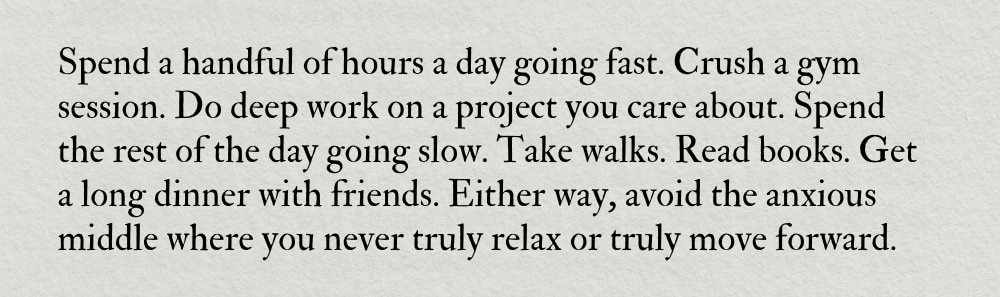
👉🏽 We need to get out of the middle.
For the moment though, there are too many of us stuck in the middle - seeing this rapidly changing technology and wanting to be excited and carefree, but worried about very real signs that we need some kind of caution to avoid consequences we’re just working through now - like climate impact, copyright issues, ad-driven business models, and labor shocks.
The problem is, that leaves us stuck not fully embracing the transformative potential, but uneasy about fully shunning it.
We need to get out of the middle.
The middle is where we are simply consumers of products not built by or for us. Paying $20/month for an math machine, thinking it’s a magic machine, accepting answers that generally look right but never being really sure.
The middle is where we again get handed products funded by misaligned business models, being told it’s for our best because free is “what we want”.
The middle is where we have a constant sense of dread and worry. Where we can’t really get excited or be optimistic because there are no boundaries or brakes being built in and so we need to be those boundaries.
The middle is no place to be. Because it looks and seems like it’s reasonable and rational but it’s neither. It’s exhausting and serves no one.
What we need instead is a “dialectic bridge”. That allows us to traverse each side freely and easily. To go from the best parts of both worlds. To deeply understand the merits and drawbacks of each and to choose for our own selves and our own families which serves us best.
✨ welcome to the beautiful chaos
So that’s what this space will be becoming. A bridge that gets to know each land as deeply as it can. That asks hard, uncomfortable and sometimes unknowable questions.
This definitely isn’t for everyone. I know plenty of people who love being in one camp or the other. I respect the clarity of their convictions that allows them to be all-in in a single purpose.
But for the past decade I’ve lived in the land of both - seeing the extraordinary impact technology can have in our lives, while understanding that the real answer to so many of the questions we’re asking at home lies not in a machine but with each other.
So I want to lean into those inconsistencies, those inconvenient truths, those big hairy questions.
🧐 There are 3 kinds of questions of I want to ask:
🙋🏽♀️ Deep questions - Reflections on the bigger, philosophical questions. Ones that grapple with cross purposes, impossible tradeoffs, decisions with imperfect information.
LLMs (large language models) aren’t built to model non-linguistically represented intelligence (eg. physical or emotional or relational intelligence). Instead it models it through imperfect descriptions. It’s also trained on reward functions oriented towards helpfulness and agreeableness, 1st order goals that don’t align perfect with the often 2nd and 3rd order goals of relationships, human thriving and care. So what does that mean? Do we need specialized models like being done for physical/embodied intelligence? Or do we need to collect the right kind of data to have it included in the large datasets?
What does it mean to struggle? If we can build a machine that makes everything easy for everyone, should we? Or do we lose something deeply critical to our human experience?
What if we’re outsourcing the wrong bits to tech? Instead of the doing which is increasingly connected to purpose, maybe it’s the coordinating? Or maybe it matters on the what - if we deem the work meaningful or not? Or maybe it’s the defaults we need to shift?
What are schools for? Teachers? Is it simply for knowledge transfer or is there something greater?
🤔 Personal reflections - what it feels like for me, the flawed, biased human asking these questions as a parent, and a person and a neighbor. But also what I’m finding delightful and funny and joyful…. all the things I’ve been sharing in 🖐🏽 The Five.
💬 Practical how-tos and experiments - one of my biggest frustrations is that there is plenty of commentary on needing to pay attention or impending job losses or transformation of education/healthcare/work but very little in the way of actual tools or guidance that connect at the realities of most people’s lives.
It feels like there are many people pointing to this really cool mountain, shouting about how amazing the view is from the top. For some, we have training and equipment to start ascending the sheer wall. But for most, we need a rope, a guide, a path. I want to figure out what a good rope can be.
Taking the format of How-Tos we’ve done in the past, I want to turn to things like How-To Build A Claude Code Thing With Your Kid, and How to Host a Neighbor Night or How To Know if Your AI is Making Shit Up.
But I also want to build little product experiments and do workshops and conversations where we go deeper - on both side - tech and community.
🌱 Small, but good.
Above all, I want deep engagement, not big numbers. I want conversations and nuance. I want impact, not performance.
So I’m starting over - the only way I know how. Serving a small number of people really well and growing by serving them increasingly better.
I have one goal - each week have you more hopeful, more considered and more active in navigating our tech and community. And be so good you can’t help but share with a friend.
If this sounds important and interesting to you, then please hit the button below and join me.
We have a choice. We can skim the surface or we can dive deep. Into the complicated, the messy, the chaos.
Let’s dive.


